Drawer dividers for small apartments: what to buy first is not really a question about the prettiest tray. It is a question about which drawer slows down your day, what gets tangled inside it, and whether one simple divider would make that drawer easier to reset after normal use.
In a small apartment, drawers often carry more pressure than they should. One kitchen drawer may hold utensils, batteries, tape, takeout packets, and a screwdriver. One dresser drawer may hold socks, workout clothes, scarves, and off-season extras. A divider helps only when it gives a narrow group a clear home. If it just slices clutter into smaller clutter, skip it.
Why Drawer Dividers Matter in Small Apartments
Small homes usually have fewer backup storage zones. That makes each drawer more important. A messy drawer can steal time because you have to search, lift, and shuffle before finding one daily item. A good divider shortens that search by keeping the most-used items visible and separated.
Drawer dividers also create limits. When one section is for socks, one for belts, and one for small accessories, the drawer tells you when the category is full. That quiet limit is useful in an apartment because storage products should not become permission to keep unlimited extras.
For general product-safety context, the U.S. Consumer Product Safety Commission maintains official consumer safety and recall information through the CPSC website. You do not need a government source to choose a sock divider, but it is a useful reminder to treat unstable, overloaded, or child-accessible storage conservatively.
Start With the Drawer Job
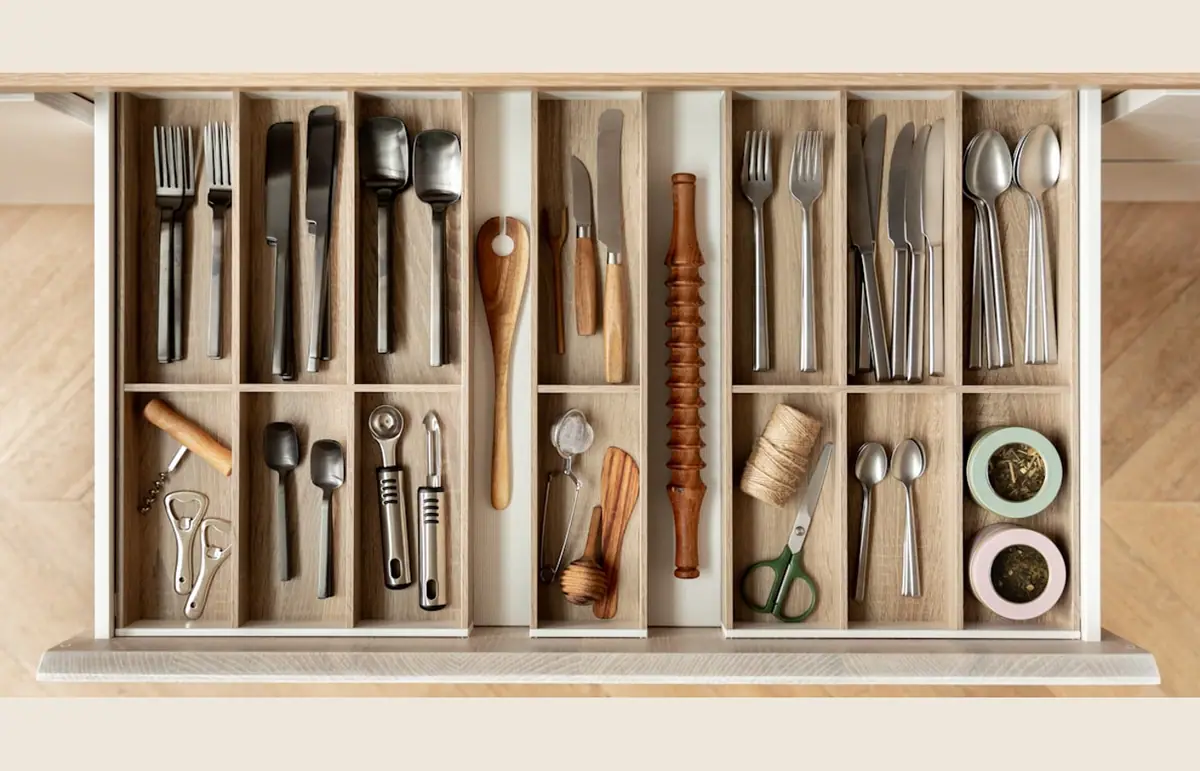
Before buying anything, choose the drawer job. A drawer divider should solve one real friction point: utensils sliding together, socks unfolding, toiletries rolling, office supplies mixing, or small kitchen tools hiding under larger ones.
If a drawer has five unrelated categories, sort the categories before shopping. A divider cannot fix a drawer that is doing too many jobs. It can only make a clear job easier to maintain.
Good first-drawer candidates
The best first drawer is opened daily and contains small items that shift around. Kitchen utensil drawers, dresser sock drawers, nightstand drawers, entryway catchall drawers, bathroom vanity drawers, and desk drawers are usually better starting points than deep storage drawers you rarely open.
Drawers to wait on
Wait on drawers that hold heavy tools, tall products, loose cords, spare hardware, or seasonal items. These often need a different system first, such as a small bin, pouch, label, or fewer items.
What to Check Before You Buy Drawer Dividers
Measure the inside width, depth, and height of the drawer. Include any curved sides, center rails, screw heads, drawer stops, or raised corners that reduce usable space. A divider that technically fits the opening may still catch when the drawer closes.
Next, measure the items. A divider should match the tallest, longest, or most awkward item in the drawer, not the average item. If a spatula, scarf, charger, or hairbrush does not fit naturally, that section will become frustrating.
Finally, check product guidance. Some expandable dividers use spring tension, some trays need a flat drawer bottom, and some organizers are sized for specific cabinet or wardrobe systems. Manufacturer pages, including IKEA product support, can help you find assembly guides and product-specific instructions when you are matching an organizer to a known furniture system.
What to Buy First
Start with one of these simple divider types, based on the drawer problem you actually have.
- Expandable straight dividers: best for dresser drawers, socks, underwear, scarves, and folded soft goods where long lanes are enough.
- Shallow tray organizers: best for kitchen utensils, desk supplies, makeup, and bathroom items that need several small sections.
- Small open bins: best for mixed catchall drawers because each bin can hold one category without locking the whole drawer into a fixed layout.
- Adjustable grid dividers: best for many small items of similar size, such as socks, ties, craft supplies, or small accessories.
- Non-slip drawer liner: useful when the drawer contents are mostly right but slide every time the drawer opens.
For a first purchase, avoid buying a large matching set unless you have already tested one drawer. One useful divider teaches you more than a full apartment kit that does not match your real drawer sizes.
How to Choose Drawer Dividers Step by Step
- Empty one drawer. Work with only one drawer so the decision stays small and specific.
- Name the drawer job. Write down the category in plain language: daily utensils, socks, desk tools, bathroom backups, or entryway small items.
- Remove anything that belongs elsewhere. Dividers work better after the drawer stops holding unrelated items.
- Measure the drawer interior. Check width, depth, height, and the space needed for the drawer to close smoothly.
- Choose one divider type. Pick straight dividers for lanes, trays for many small objects, or bins for mixed categories.
- Keep the daily item easiest to reach. The item used most often should not sit behind a wall of occasional items.
- Review after one week. If the drawer is not easier to reset, move the divider or remove it.
Pros and Cons
Drawer dividers are useful when they support a clear routine. They become clutter when they are bought before the drawer has a clear job.
They make small items visible
Dividers stop socks, tools, utensils, and accessories from sliding into one mixed layer.
They create useful limits
Each section shows when a category is full, which helps prevent quiet overbuying.
They are easy to test
Most drawer dividers can be moved, adjusted, or reused in another drawer if the first setup does not work.
They can waste space
Thick dividers and trays can reduce usable drawer space if the drawer is already tight.
They cannot fix mixed storage
If the drawer holds too many unrelated categories, a divider only organizes the confusion into smaller sections.
Common Drawer Divider Mistakes to Avoid
The first mistake is shopping by drawer photo instead of drawer measurement. A tray that looks tidy online may waste a narrow apartment drawer.
The second mistake is buying too many compartments. More sections are not always calmer. If the sections are too small, items become harder to return.
The third mistake is ignoring height. A divider that stands too tall may scrape the cabinet frame or block the drawer from closing.
The fourth mistake is dividing before decluttering. Remove duplicate, broken, expired, or misplaced items first so the divider is not asked to store things the drawer should not hold.
A Simple Checklist
- Is this drawer used daily? Start where the improvement will be felt often.
- Does the drawer have one main job? If not, sort the categories before buying.
- Did I measure inside dimensions? Width, depth, and height all matter.
- Will the drawer close easily? Leave clearance above the organizer and around any rails or stops.
- Are the sections easy to refill? If returning items feels fussy, the layout will not last.
- Can this divider move later? A flexible first purchase is safer than a rigid custom setup.
Frequently Asked Questions
What type of drawer divider should I buy first?
Buy the simplest divider that matches one daily drawer. For soft goods, try expandable straight dividers. For utensils or desk supplies, a shallow tray usually works better.
How often should I review a divided drawer?
Review it after the first week, then during your normal laundry, grocery, or cleaning reset. If items keep landing outside their sections, adjust the layout.
Are adjustable drawer dividers better than fixed trays?
Adjustable dividers are better when drawer sizes or item categories may change. Fixed trays are better when the drawer holds small, predictable items in the same routine every day.
Can drawer dividers waste space?
Yes. Thick walls, too many tiny compartments, and trays that do not match the drawer can waste space. Measure first and start with one drawer before buying a set.
Final Thoughts
The best drawer dividers for small apartments are the ones that solve a daily drawer problem without adding a complicated system. Start with one drawer, one job, and one flexible product. Measure carefully, keep the most-used item easy to reach, and let a normal week show whether the setup deserves to stay.
If the drawer closes smoothly and resets quickly, the divider is doing its job. If it makes the drawer feel fussy, crowded, or hard to refill, remove it and simplify the drawer before trying again.